Shipping products from China is a critical factor for importers, often forcing a tough balance between speed and cost. This guide exposes you to all the mainstream and innovative shipping solutions available, especially focusing on practices friendly to small businesses and e-commerce.
Whether you’re moving a small 20kg shipment or thousands of kilograms, this post will help you select the optimal solution.
1. Who Handles Your Shipment? The 4 Key Roles
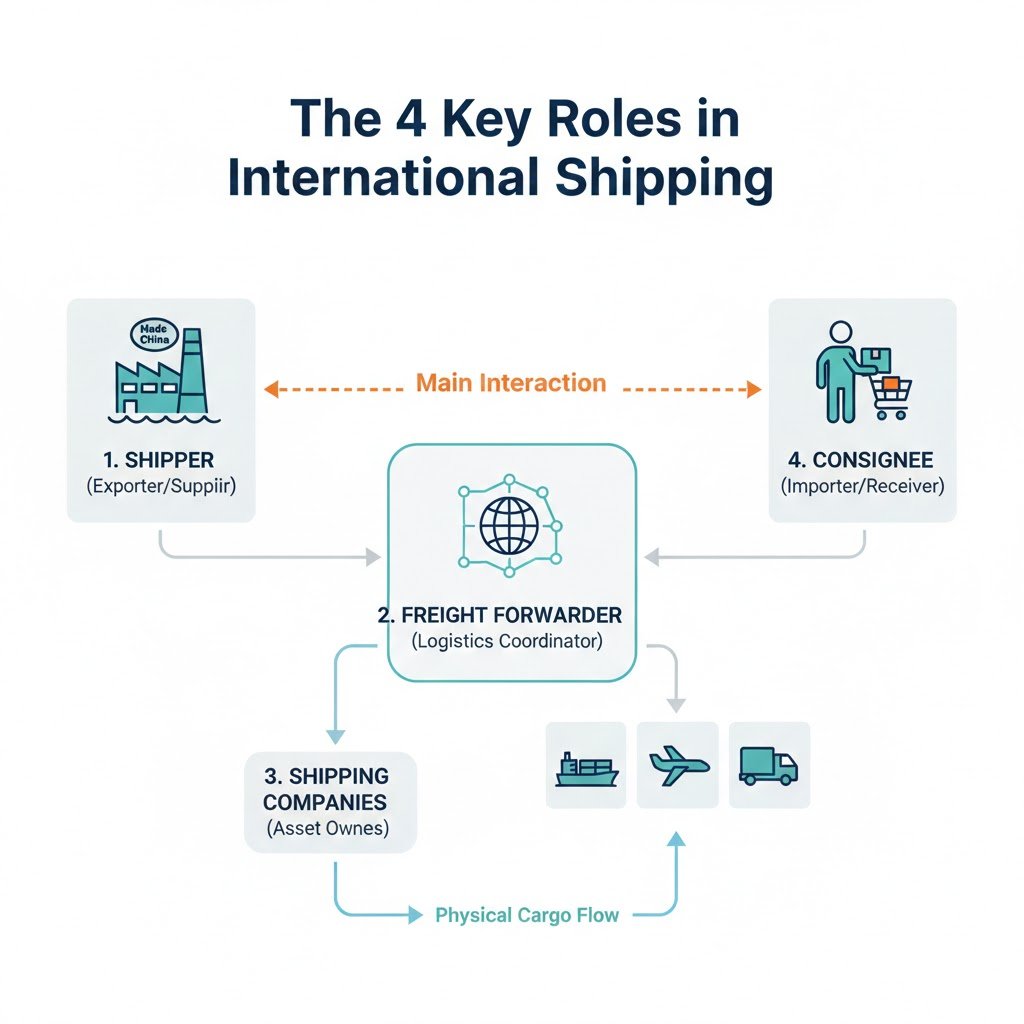
In international shipping, four main players are involved in the process:
| Role | Definition | Your Interaction |
| Shipper | Your product supplier (the exporter). | Direct contact (provides the cargo). |
| Consignee | You, the importer (the receiver). | Direct contact (receives the cargo). |
| Shipping Companies | Companies owning the physical assets (trucks, vessels, aircraft) that move the goods. | You never deal with them directly. |
| Freight Forwarder | A crucial broker who coordinates all shipping companies, handles logistics, and manages import/export processes from pick-up to delivery. | You or your supplier must find one. |
Choosing a Freight Forwarder
- Supplier’s Forwarder (Recommended for New Importers): Ask your supplier to arrange shipping. While they may add profit to the fee, it’s safer. If the cargo is lost or damaged, the supplier shares responsibility since it’s their choice of forwarder.
- Your Own Forwarder: Search on Google or use platforms like Freightos or Flexport. Freightos is user-friendly for quotes, but remember:
- Quotes are often just to the destination city, not your final address.
- It’s best suited for traditional sea freight or air freight to major Western markets (North America, UK, Western Europe, Australia).
2. Understand 5 Essential Incoterms (Trade Terms)
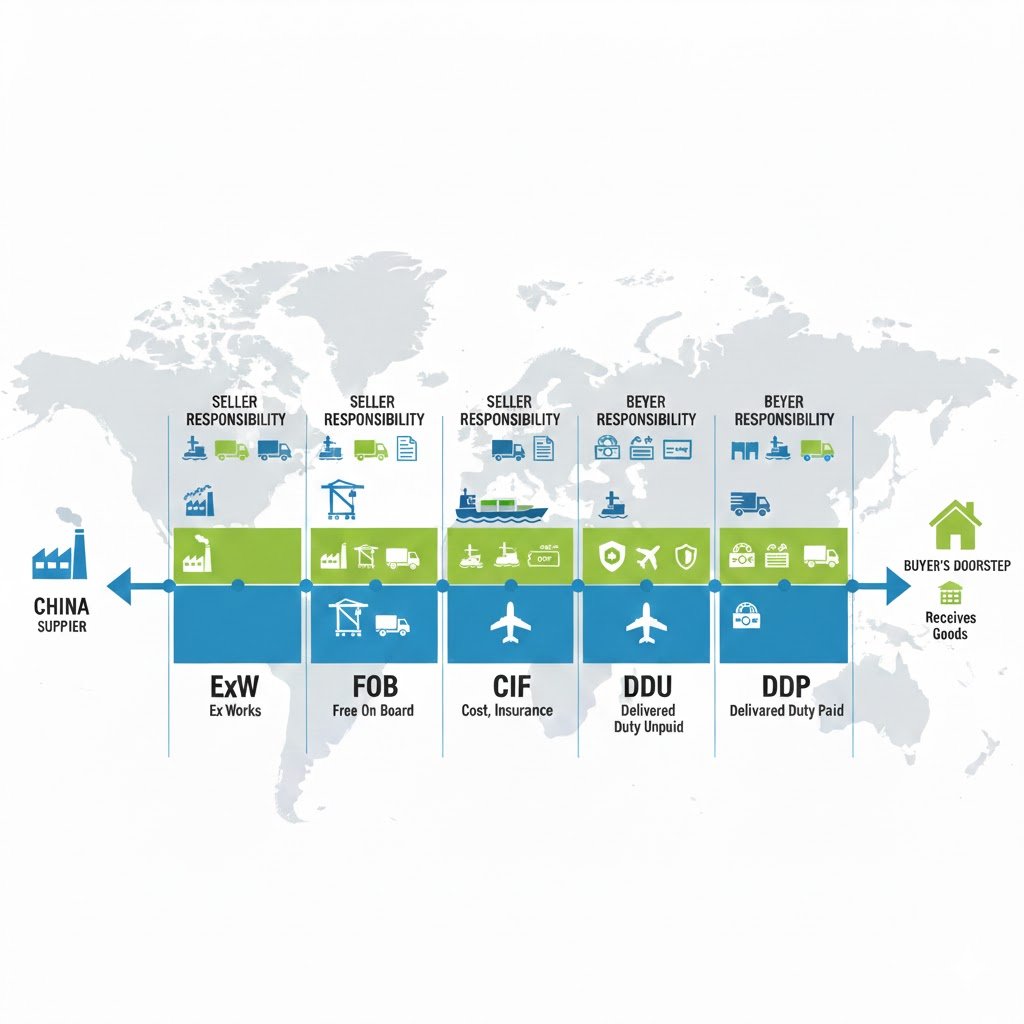
Incoterms define the responsibilities and costs between the buyer (you) and the seller (supplier). Always confirm the Incoterm when asking for a price.
| Incoterm | Full Name | Seller Responsibility | Buyer Responsibility |
| ExW | Ex Works | Product cost only (at their warehouse). No shipping/export service. | All costs from pick-up at warehouse to final delivery. |
| FOB | Free On Board | Deliver to a China seaport/airport + Export costs. | All costs from China port/airport to final delivery. |
| CIF | Cost, Insurance, and Freight | Deliver to a seaport/airport in your country + China-side costs + Insurance. | All costs from your country’s port/airport to final delivery + Import clearance. |
| DDU | Delivered Duty Unpaid | All shipping costs to your doorstep. | Import duties/taxes + Customs clearance. |
| DDP | Delivered Duty Paid | All shipping costs to your doorstep + Import duties/taxes. | Receives the goods. |
Note: If shipping by courier (FedEx, UPS), you should usually pay the supplier in ExW term, as the courier handles everything from the supplier’s door.
3. Shipping Solutions by Cargo Size & Type
The best solution depends heavily on your shipment’s size and weight.
A. Air Courier (Express Shipping) – For Cargos Below 500kg
The easiest, fastest, and most expensive solution, often used by new importers and e-commerce sellers.
| Aspect | Details |
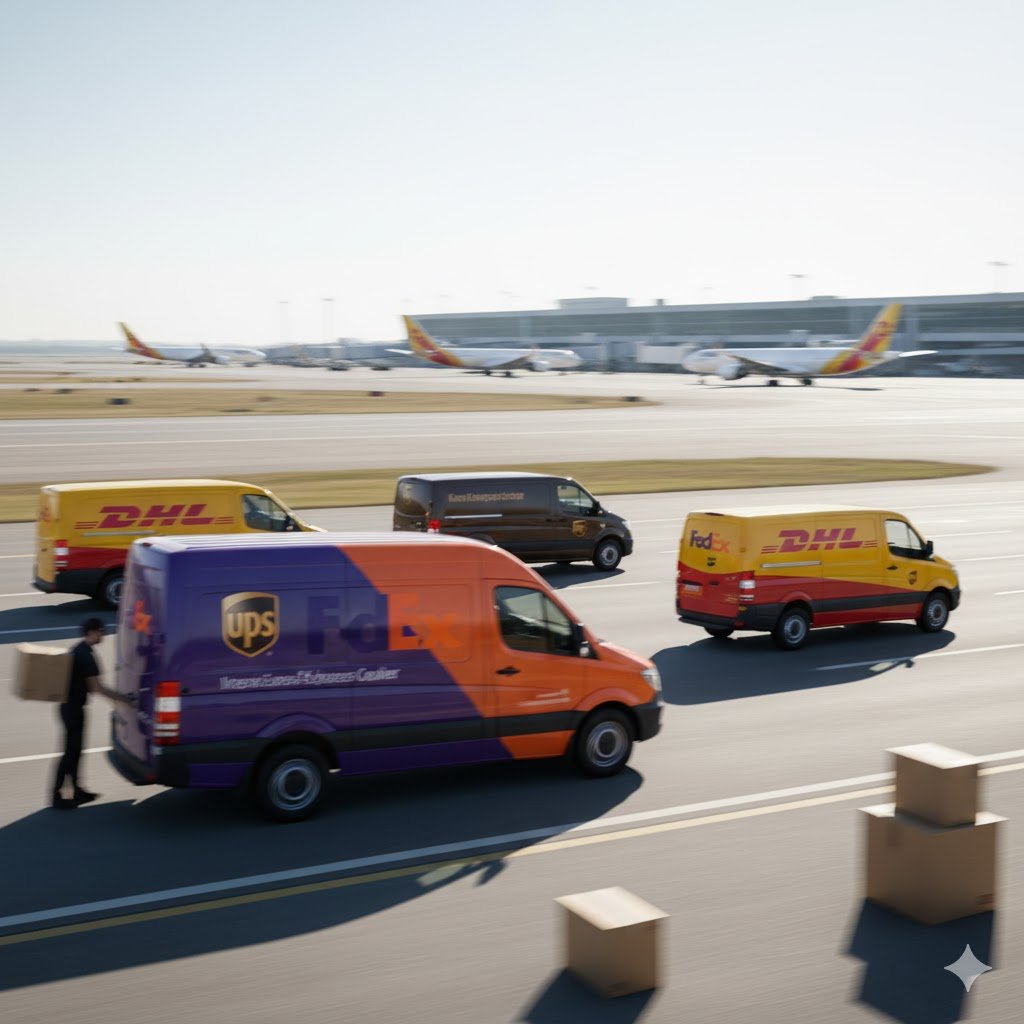
| Providers | FedEx, DHL, UPS, TNT. They handle the entire process (pick-up, export, import, delivery). |
| Speed | Very Fast: Typically 3-5 days to most countries. |
| Cost | Most expensive. Around $6-$7/kg (North America/W. Europe, but highly variable). Minimum charge applies for small parcels (less than 20kg). |
| Hacks | Don’t contact the courier directly. Use a Chinese supplier/agent who gets 40%+ discounts due to large volume. |
| Crucial Concept: Dimensional Weight | Shipping is charged by the greater of the actual weight or the dimensional weight. |
| Formula | Length x Width x Height(cm) / 5, 000 |
| Verdict | Not economical for large-sized but low-value products (e.g., paper towels). Items with lithium batteries, liquid, or powders are restricted (may cost 50%+ more). |
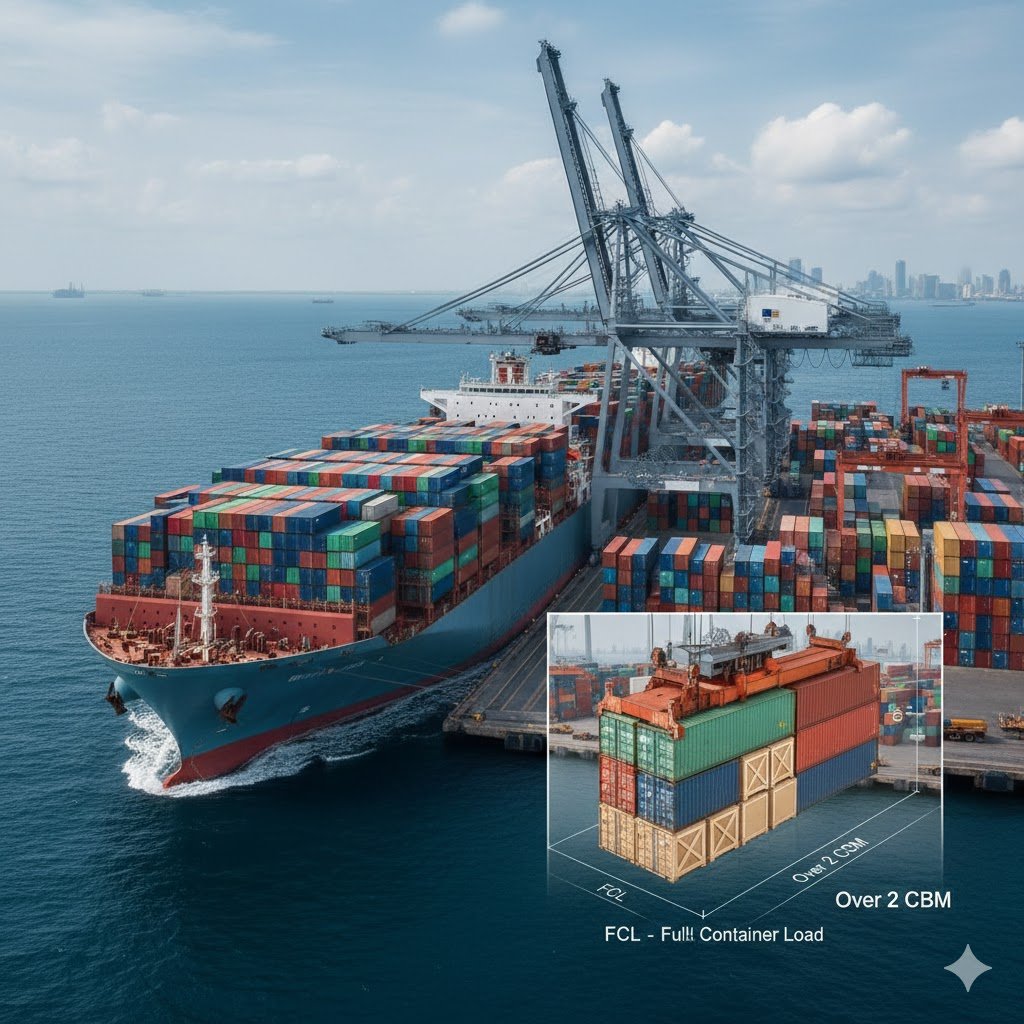
B. Sea Freight (LCL/FCL) – For Cargos Over 2 CBM
The slowest and cheapest method, operated by freight forwarders coordinating multiple parties.
- FCL (Full Container Load): For shipments over 20 CBM (book an entire 20″ or 40″ container).
- LCL (Less than Container Load): For smaller shipments, your forwarder shares a container with others.
- Volume Recommendation: Do not choose sea freight if your shipment is less than 2 CBM, as the fixed costs make the average cost-per-CBM too expensive.
| Aspect | Details |
| Speed | Very Slow: Typically 30-50 days (China port to your door). |
| Cost | Cheapest: About 85% lower than air courier. Costs vary significantly: ~$100-$300/CBM to US/Europe before the 2020-2021 price hikes. |
| Cost Breakdown | Ocean freight is only a small part; most costs are at the destination port (importing, customs, land shipping). |
C. Air Freight – For Cargos Above 500kg
Similar to sea freight, this uses a freight forwarder to book space on commercial airlines.
| Aspect | Air Freight (Forwarder) | Air Courier (FedEx, etc.) |
| Cost | Cheaper: ~20% lower than courier. | More Expensive. |
| Dimensional Weight | L x W x H / 6,000 (Lower Dimensional Weight). | L x W x H / 5,000 (Higher Dimensional Weight). |
| Clearance | More tedious (may need more compliance certs). | Easier clearance. |
| Verdict | Choose Air Freight for >500kg to save cost, especially for big-sized/light-weighted goods. Choose Courier for <500kg for better service and speed. |
D. Railway Freight – For European Full Container Load
A middle-ground solution for shipping to Europe (not the US).
| Aspect | Details |
| Speed | Moderate: ~15-20 days (faster than sea). |
| Cost | Moderate: ~2 times the cost of sea freight (cheaper than air). |
| Limitation | Mostly requires FCL (Full Container Load). Limited routes, mainly servicing Eastern Europe and Western Asia. |
4. E-commerce and Small Business Focused Solutions
Sea/Air Freight + Local Courier (The E-commerce Favorite)
This method combines the affordability of ocean or air transport with the last-mile efficiency of a courier (like UPS in the US).
| Combination | Cost vs. Air Courier | Time vs. Sea Freight | Target User |
| Sea + Courier | ~$2/kg (much cheaper). | ~20 days (20%-50% faster). | Amazon FBA sellers, small importers (50-100kg+). |
| Air + Courier | ~20% cheaper. | Only a few days slower. | When you need speed and small savings. |
Pro Tip: This is the most popular solution for Amazon FBA sellers shipping small quantities. Look for freight forwarders based in China who specialize in shipping to Amazon.
Epackage (China Post/Yanwen) – For Dropshipping (<2kg)
This is the perfect solution for very small, light-weight packages (e.g., cheap jewelry, gadgets) used by dropshippers.
- How it Works: Providers like China Post and Yanwen ship large batches of parcels by air, then use local postal services for the final delivery.
- Advantages:
- Minimum shipment can start at just 20 grams.
- Shipping fee charged by the gram.
- Disadvantages:
- Slow: 10-20 days (or more).
- Not stable; packages can get lost.
5. Handling Customs Clearance
You need to prepare for both Export Clearance (in China) and Import Clearance (in your country).
Essential Documents (Required for Both Export and Import):
- Contract
- Commercial Invoice
- Packing List
- Bill of Lading
- Certificate of Origin
For Export: Your supplier usually handles this.
For Import: You must pay customs duties (based on product/country) and may need additional compliance certifications. Consult your freight forwarder or customs broker for exact requirements and duty rates (e.g., MPF, HMF for the US).
To Wrap Up
You now have a clear understanding of the logistics landscape for shipping from China, from the slowest and cheapest sea freight to the fastest, most expensive air courier, and the balanced e-commerce solutions.
Which shipping solution is right for you?
- <500kg, Need Speed: Air Courier (FedEx, UPS).
- >500kg, Need Speed & Savings: Air Freight (through a forwarder).
- >2CBM, Need Lowest Cost: Sea Freight (LCL/FCL).
- 50-200kg, E-commerce, Balanced: Sea/Air + Local Courier.
- Dropshipping, <2kg: Epackage (China Post/Yanwen).